Do you favor margin or revenue?
Is an Appointment-Only Shop Schedule Wise or Madness?
read more



Do you favor margin or revenue?
Modern vehicles equipped with Advanced Driver Assistance Systems (ADAS) are truly marvels of engineering. What started as high-end options found only on luxury cars can now appear as standard equipment on some econo-boxes (e.g., blind spot detection). That means it is more likely for you to cross paths with ADAS during even a seemingly minor repair. Some shops think that they can remove and replace a sensor or even change a windshield without performing post-repair ADAS calibration. That’s a bad idea.
It makes sense that any time you service a bumper sensor or camera, it probably needs to be calibrated. But ADAS designs are extremely complicated and can reach farther across the vehicle than you think. Here are just a few jobs that can lead to post-repair ADAS calibration:
This is by no means an exhaustive list; ultimately, you must refer to the OEM repair instructions for guidance.
One of the repairs that helped bring post-repair ADAS calibration to people’s attention is windshield replacement due to forward-facing cameras. Some vehicles mount cameras to the windshield itself, while others mount them in the sunvisor area just behind the windshield.
Unfortunately, some technicians believed they could simply leave the camera plugged in and hanging from its wires to prevent triggering a fault code. They also wrongly thought they could just put the camera back—except the camera must be calibrated to its location with extreme precision. Installation by a tech “eyeballing” the camera’s location will not cut the mustard here.
Even if the camera is not mounted to the windshield, differences in glass refraction can affect how the camera “sees” through a new glass windshield. Simply put, replacing a windshield on an ADAS-equipped vehicle almost always requires calibration.
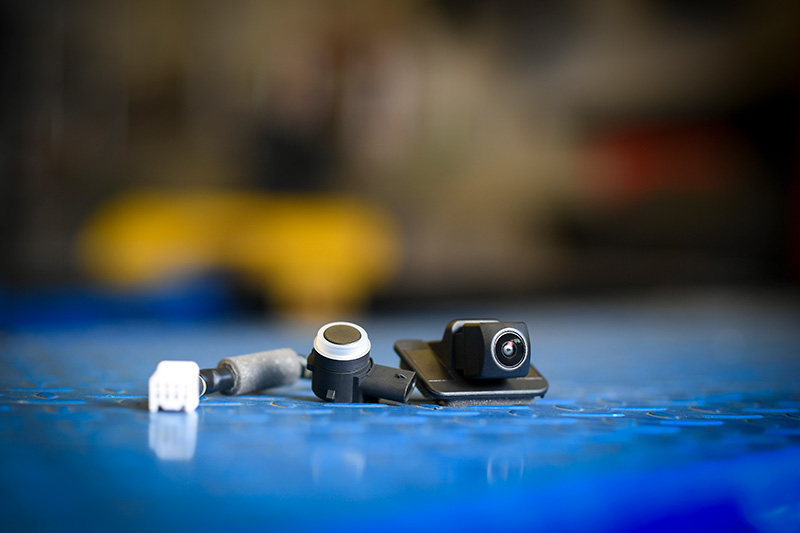
Backup camera. Photo: Mike Apice.
In order to sense the world around it, ADAS relies on certain absolute factors. Calibration is how ADAS sets a baseline status for the vehicle within its surroundings. Without proper calibration, ADAS won’t “see” the world as it truly exists. Extremely precise calculations are based on ADAS sensor inputs. Just one degree of deviation on a sensor angle can add inches or even feet to the distances perceived by ADAS. Many of these systems build on each other and rely on precise information to choose the proper response to a situation. If the forward-facing camera can’t see the stopped car precisely, the automatic emergency braking won’t prevent the collision. Alternatively, it could engage emergency braking when it is not needed, which could lead to a dangerous situation.
Drivers expect ADAS to help keep them safe. If a vehicle’s ADAS is not operating at its full potential, the results can vary from annoying to catastrophic. A safety system like automatic braking may not activate when it is needed the most. There could be issues with sporadic steering, throttle or braking. What was supposed to be a gentle lane assist nudge could actually force the vehicle into an opposing lane. If the ADAS is giving false warnings, the driver may either ignore it or turn off the safety feature completely, thus negating the point of having a safety system in the first place!
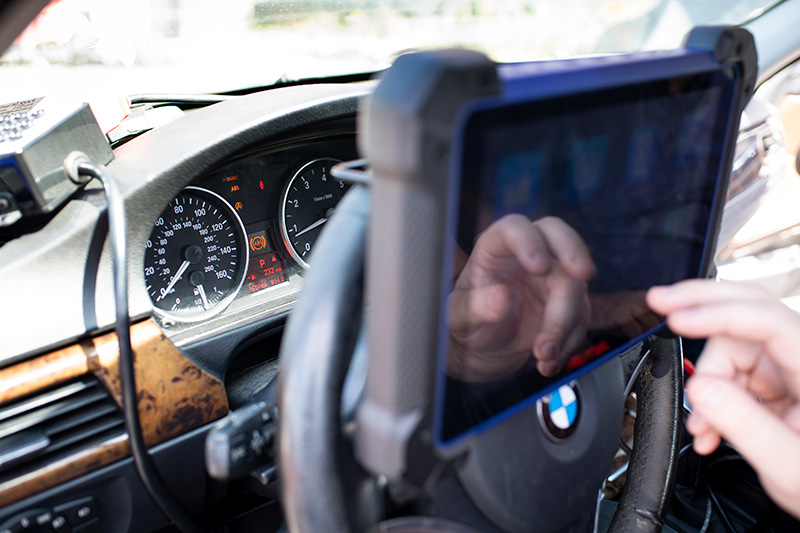
ADAS Calibration. Photo: Mike Apice.
Aside from potential legal liability for an improper repair, insurance companies may also deny claims if ADAS issues are found, forcing the shop into an expensive situation or facing insurance subrogation.
It is worth restating that any repair that may impact ADAS on a modern vehicle needs to reference the OEM repair instructions.
The collision industry experts at I-CAR (Inter-Industry Conference on Auto Collision Repair) have put together an excellent reference tool to help you determine if a repair may require ADAS calibration. Unfortunately, ADAS calibration often takes a large amount of space and specialty equipment.
The articles and other content contained on this site may contain links to third party websites. By clicking them, you consent to Dorman’s Website Use Agreement.

Don’t just rely on brake fluid color to determine its condition.

Technician A argues that the 20/20 Rule captures most lab scope signals, while Technician B counters that a DSO doesn’t record signals in real time but samples and plots voltage data. Who is correct?

Technician A says the ECM’s main job is to keep emissions within certified limits. Technician B says fuel trim PIDs show corrections to fuel calculations. Who is correct?
Supplemental information to make your first rodeo a little easier.
There’s no magic bullet—but there are a few arrows you can pull from your quiver.

Technician A says an empty DEF tank can cause a no-start condition. Technician B says DEF quality should be checked when SCR faults are present. Who is correct?
Participation in this forum is subject to Dorman’s Website Terms & Conditions. Please read our Comment Policy before commenting.