Do you favor margin or revenue?

Is an Appointment-Only Shop Schedule Wise or Madness?
read more



Do you favor margin or revenue?
I’ll never forget this one day in the shop. One of the other techs was wrestling with an electrical gremlin and swung by my bay for some backup.
“Pete, mind giving me a hand? I’ve got this GMC pickup with a blower motor that’s running super slow. I checked the power and ground to the motor—they seemed fine—so I went ahead and ordered a new one. Just slapped it in, and it’s still doing the same damn thing.”
Look, I don’t know a single tech who doesn’t get why you gotta verify power and ground when diagnosing an ECU issue, but honestly, that same test applies to any electrical gizmo you’re thinking about swapping out. No electrical load; a light bulb, fuel pump, or an ECU, can do its job without solid, clean voltage coming in and an equally solid path back to ground.
Anyway, back to the tale. I dropped what I was doing and headed over to his stall. I asked him to walk me through how he’d tested the blower motor’s power and ground. First thing he did? Unplugged the connector right at the motor.
That was mistake number one.
Next, he grabs a test light, clips the ground to the instrument panel brace, and pokes the probe into the open connector. With just two wires, he’s got a 50/50 chance of hitting the power feed first. He turns the key on, cranks the blower switch to “high,” and the test light lights up bright.
Mistakes two and three right there.
He looks at me and goes, “See? Power’s good.” Then he jams a T-pin into the ground side of the connector, hooks the test light’s clip to it, and bam—the light glows bright again. “Ground’s solid too. What the hell could it be?”
Oh man…
First off, my buddy disconnected the load from the circuit and tested an empty connector. And yeah, most folks know why that’s bogus. No load means no current flow, so you’re just measuring open circuit voltage (OCV). Might as well test at the battery itself because measuring OCV tells you zilch about how well the circuit can perform.
Without diving into a full-on electrical theory class, the reason circuits crap out is usually some change in resistance from whatever fault’s lurking. Like a loose connection jacking up resistance, or corrosion adding extra ohms. Those are the “unwanted” thieves that steal voltage from the main load; in this case, the blower motor. And when resistance goes up, what happens to current? It drops.
Let me make that clear. All the voltage in a circuit gets used up overcoming resistance. Everything in there has some resistance, but the load (the thing doing the work) is the big kahuna we care about.
But toss in a thief, that unwanted resistance, and it robs the load of its full share of voltage.
With the connector unplugged, the circuit’s open, right? No current flow. No current means no voltage drop to measure. That was mistake two.
Mistake three was grounding his test light at the instrument panel brace. Even if he’s testing it right, he’s only checking part of the circuit. We all know power comes from the battery, but those electrons gotta make it all the way back too. Always ground your test gear at the battery, even if you need a 20-foot lead.
I laid this all out for my friend, just like I’m telling you. We hooked the blower motor back up, turned the key on, and I ran it through all the speeds. It worked, but way slower than normal across the board. Next, I had him backprobe the connector carefully and measure voltage at the power feed with a voltmeter and not the test light.
He reads a hair over 6.0 volts. Jackpot!
Why? All voltage gets eaten by the resistances in the circuit, each taking its cut from the main load.
Usually, it’s just a few tenths of a volt. The engineers plan for that. But they can’t plan for crap like a damaged pin, corroded terminal, or loose battery ground. Those add resistance and steal voltage.
When he measured at the blower’s power feed, we expected a voltage close to battery voltage with the key on. Seeing only 6.0 volts screamed that a thief was between the motor and the battery’s positive terminal, hogging the rest.
We knew it was there; now to flush it out. Trace back toward the battery, hitting easy spots first; connections, switches, splices. When the meter jumps back to near-battery voltage, you’ve passed the thief. Then double back like you’re tagging a runner in baseball till you pin the sucker down.
For my friend, it was a breeze. First stop was the main harness connector through the firewall. On the interior side, the same 6.0 volts as at the motor, so the fault’s not in the cab, it’s the engine side.
Engine side? Voltmeter shows almost full battery voltage, minus the normal few tenths that we expect.
We popped the connector open, which took some elbow grease, and boom. The power feed pin was overheated and burned, creating that extra resistance that was stealing voltage. Swapped the connector and pins, and the motor got its full juice back.
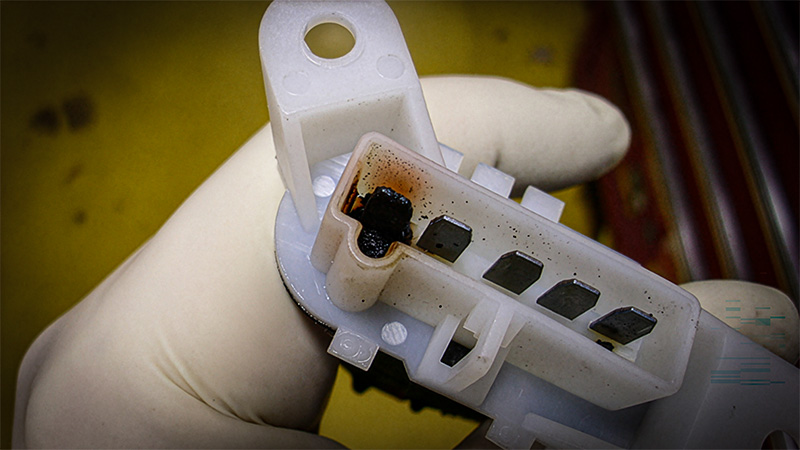
The damaged connector was the source of the unwanted resistance.. Photo: Pete Meier.
Measure what’s going into the load with it connected, compare to system voltage under load. Get as close to the load as possible, negative lead at battery ground to test the whole path. Then flip to the ground side. Should be just a few tenths max.
What if we had seen voltage there, say 6.0 volts on the ground side? What would it mean?
This trips up so many folks, and I got hung up on it for years, too. Don’t feel bad if it’s confusing. How can you measure voltage when both leads are on grounds?
It’s that thief robbing voltage from the load. We think linearly. Voltage flows from battery to load to ground, so thieves must be upstream.
Wrong.
A ground-side reading means the thief is between the load and the battery’s negative terminal. You’ll see the correct voltage going in, but not the correct voltage coming out!
The thief is on the other side, demanding its cut. That’s what you’re measuring—the voltage it’s stealing. It’s not linear. Here’s another way to think of it.
These issues hit the ground side of electrical circuits most often. Don’t let that meter reading freak you out. Anything over a few tenths on the ground side is a huge red flag pointing to where the thief hides. Hunt it down like we did on that GMC. Work toward the battery’s negative terminal until readings normalize, then backtrack to nail it.
Want to learn more about electrical troubleshooting? Check out the training resources we have for you in the Dorman Training Center.
The articles and other content contained on this site may contain links to third party websites. By clicking them, you consent to Dorman’s Website Use Agreement.

Don’t just rely on brake fluid color to determine its condition.

Technician A argues that the 20/20 Rule captures most lab scope signals, while Technician B counters that a DSO doesn’t record signals in real time but samples and plots voltage data. Who is correct?

Technician A says the ECM’s main job is to keep emissions within certified limits. Technician B says fuel trim PIDs show corrections to fuel calculations. Who is correct?

Supplemental information to make your first rodeo a little easier.

There’s no magic bullet—but there are a few arrows you can pull from your quiver.

Technician A says an empty DEF tank can cause a no-start condition. Technician B says DEF quality should be checked when SCR faults are present. Who is correct?
Participation in this forum is subject to Dorman’s Website Terms & Conditions. Please read our Comment Policy before commenting.