Shop Press

Shop Press is the news and idea hub for everything related to working on cars and trucks, focusing on repair, technology, and wrenching lifestyle.

From the creative minds at:

FEATURE STORY

Hot Off the Press

What Does Dark Brake Fluid Really Mean? (VIDEO)

Description Don’t just rely on brake fluid color to determine its condition. Dorman Training Center instructor Pete Meier demonstrates how to use a quick DVOM test for a more precise brake fluid condition check.Related Videos

Beware the SAE Lead

The SAE connector is instantly recognizable to many technicians. Commonly found on electrical junctions that need the ability to be disconnected often but ought not be reversed, the plug seems like it should be a no-brainer—however, it’s anything but. If the picture...

DSO Settings – ASE Practice Question (VIDEO)

Description Technician A says that when using a lab scope, most signals can be captured using the 20/20 Rule - that is, by setting up the scope to capture a range of 0-20v on the vertical scale and setting the time base to 20ms per division. Technician B says that a...

Why Does an Electric Car Need a Radiator?

Have you ever taken a glimpse at the front end of an electric vehicle and thought, “Wait…is that a radiator?” Why does an electric car even need a radiator when it doesn’t have an internal combustion engine? Turns out there are plenty of things on an EV that need...

Does a Car or Truck’s Air Filter Stop Wildfire Smoke? (VIDEO)

Description Can a vehicle’s air filtration help keep you safe from wildfire smoke and poor air quality? While that’s a tougher standard than most systems are built to meet, don’t overlook a simple step to get the most of your existing filter.Related Videos

Forgotten Classics: The 1990-1993 Chevrolet 454 SS Muscle Truck

The early 1990s were an interesting time for those looking for raw horsepower in a fun package. Ford’s Mustang had a 5.0L V8 with 205 horsepower and 275 lb-ft of torque, not too shabby. Camaro buyers could get a 5.7L V8 that put out 245 horsepower and 345 lb-ft of...

Engine Management and Fuel Trim – ASE Practice Question (VIDEO)

Description Technician A says that the ECM's primary role in engine management is to ensure that emissions remain within the limits for which the vehicle was originally certified. Technician B says that the fuel trim data PIDs (Parameter Identifiers) represent...

Ford Door Latch Cable Repair Tips and Tricks: 926-111

“Customer states rear door inop.” If you see that line on a ticket and the make and model is a Blue Oval truck or van, what you have is likely related to the door latch. Specifically, the cable end that operates that latch has cracked and crumbled. Ford will tell you...

Service Managers: Buy Brake Fluid by the Pint

by | Jun 11, 2026

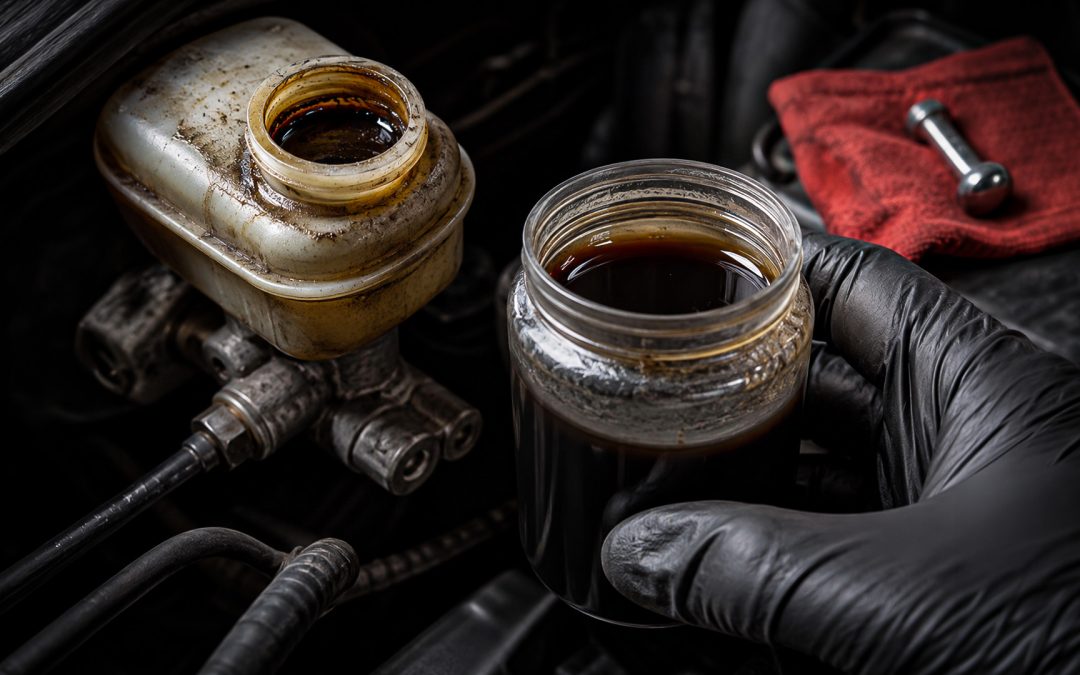
If you’re in charge of ordering the supplies for your shop, volume discounts are great when they come along. Sniff them out where you can. But brake fluid is different! Buy it in bulk, but buy it in the smallest containers you can get away with. The reason? Brake fluid is hygroscopic. And the boiling point matters more than ever.
To wit: if you read most any master cylinder cap, you’ll be instructed to use brake fluid from a sealed container. That’s to ensure that the fluid doesn’t suck moisture out of the ambient air. (That’s what “hygroscopic” means.) When brake fluid becomes waterlogged, the boiling point of the fluid is lowered, and the water can actually boil off. Fluid, as we learned from Pascal, is incompressible, but that’s not true of a gas (like steam). If the water turns gaseous, the pedal can travel without compressing the fluid and then moving the pads or shoes, which is obviously not good.

Couple this with the rise of vehicles using DOT 4 brake juice. This differs from the more common DOT 3 only in terms of having a higher boiling point. Why? Brakes are being asked to do more work that generates more heat, and the hydraulic fluid needs to work harder as well. That fact, coupled with ever-more-intricate ABS systems with faster processors and controllers, means it’s more important than ever to keep water out of the system.

Buying small, sealed containers can help you do this. Sure, if you’re finally plumbing up that old project car, buy a quart or even a gallon for the bench bleed on the master and gravity bleed of the lines and hoses that will follow. But you’ll want to toss it not long after, and for most regular fluid swaps done in tandem with a brake job, a pint or two will do you just fine.

The scant savings from buying in bulk might not be all that prudent. So get your oil in a drum—but brake fluid should be in airline bottles only.

The articles and other content contained on this site may contain links to third party websites. By clicking them, you consent to Dorman’s Website Use Agreement.
Related Articles

Shop Press Comment Policy

Participation in this forum is subject to Dorman’s Website Terms & Conditions. Please read our Comment Policy before commenting.

Subscribe
Notify of
guest
0 Comments
Newest
Oldest Most Voted
Inline feedback
View all comments