Don’t try to (needlessly) upsell me.

Writers, Print Vehicle Service Histories for Every Vehicle
read more



Don’t try to (needlessly) upsell me.
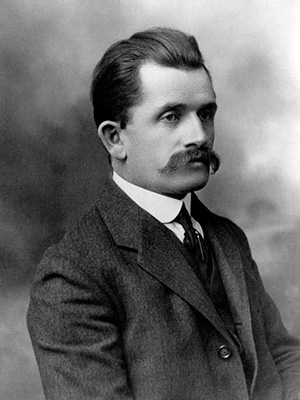
Ferdinand Porsche, circa 1905. Photo: nicht angegeben, Public domain, via Wikimedia Commons
Born in 1875 in Maffersdorf, a German-speaking village in Bohemia within the Austro-Hungarian Empire, Porsche’s impact stretches across Brass Era vehicles, racing cars, mass-market automobiles, and the foundational years of modern sports cars. His legacy lies in how he created cars that were defined by both how they worked and how they looked. As you’ll see, Ferdinand Porsche has penned some of the most famous and enduring silhouettes to ever grace the road.
During his formative years, it seems that Porsche had more in common with Nikola Tesla than Henry Ford. Surprisingly, his early work focused on electric propulsion.
Porsche’s first design, the Egger-Lohner C.2 Phaeton in 1898, featured a rear-mounted electric motor, a top speed of 35 km/h (22 MPH), and an 80-km (50-mile) range.
Just two years later, at the 1900 Paris World Exhibition, Porsche introduced the wildly innovative Lohner-Porsche “Mixte” electric motor car, which utilized wheel-hub motors for propulsion. While primitive by today’s standards, a direct line can be drawn from these “elektromobiles” to the hub motors that propel some electric bicycles today.
Porsche’s true design philosophy, however, was forged in motorsport. The burgeoning designer honed his skills in the 1920s and 1930s, creating powerful, speedy machines, far removed from his electric car roots.
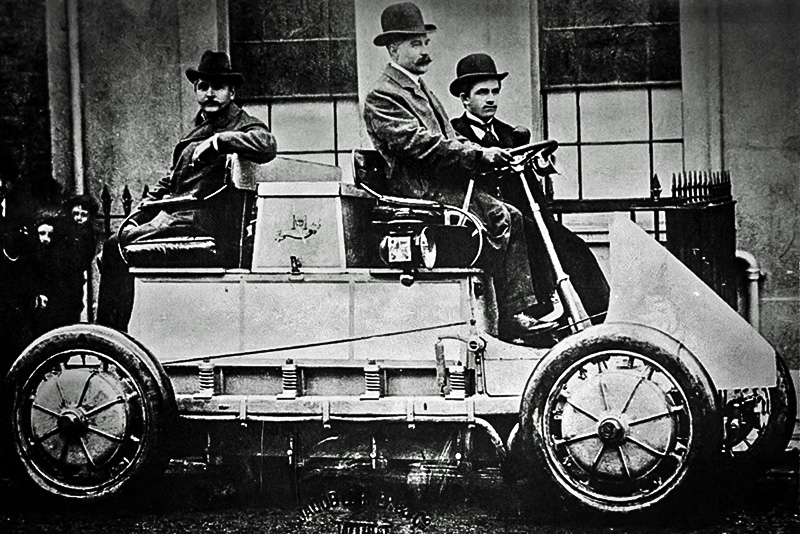
Lohner‑Porsche racecar from the early 1900s with Ferdinand Porsche beside the driver E.W. Hart. Photo: Photo from 1902, Public domain, via Wikimedia Commons.
While at Mercedes-Benz, Porsche led the development of some legendary pre-World War II performance cars. The S, SS, and especially the SSK were supercharged, high-powered machines that dominated racing and hill climbs across Europe. This trio captured the spirit of the Roaring ‘20s: massive front grilles, two round headlights, seductively curved fenders, long hoods, and exposed exhaust pipes. Art Deco on wheels, the cars’ beauty was more than skin deep as the threesome packed a wallop with huge engines. The SSK was the most brutish of the bunch, with a supercharged 7.1-liter inline six producing up to 250 horsepower and a shortened wheelbase for improved handling.
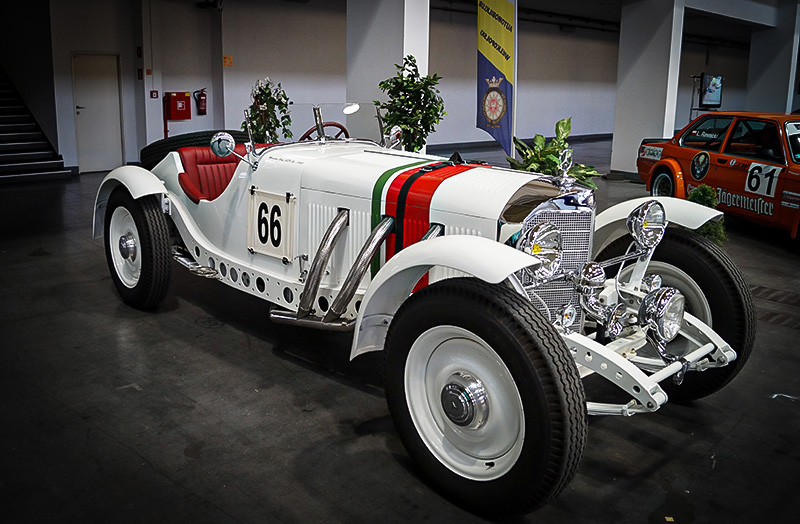
1928 Mercedes-Benz SSK. Source: Jakub “Flyz1” Maciejewski, CC BY-SA 3.0, via Wikimedia Commons.
Perhaps Porsche’s most influential racing design, the Auto Union “Silver Arrow” was built to wrestle racing domination away from the French and Italian cars leading Grand Prix racing at the time. Development of the Auto Union racer was a state-sponsored affair with German Chancellor Adolf Hitler announcing the program at the 1933 Berlin Motor Show. (Auto Union was the predecessor to the company known today as Audi.)
Rejecting convention, Porsche’s design featured a mid-mounted engine, radical weight distribution, and immense power. Early cars were powered by V16 engines until regulations changed for the 1938 season, which is when the last iteration of the car, the Type D, the most stylish and recognizable of the series, debuted. With powerful 3.0-liter V12 engines, skinny tires, and a mid-engine design, the Type D cars could be terrifying to drive but extraordinarily fast, with top speeds of approximately 300-330 km/h (185-205 MPH). Between 1935 and 1938, Silver Arrows tallied 25 victories in Grand Prix races and major hill climbs.
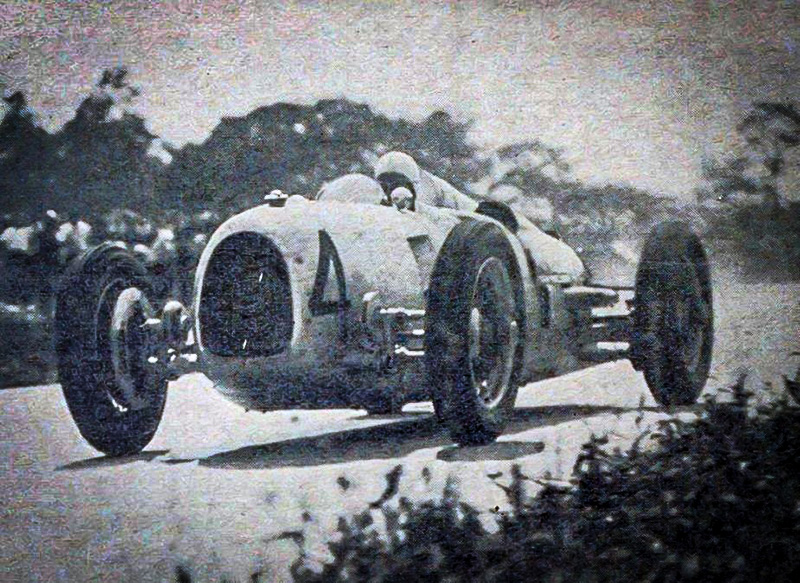
A 1934 Auto Union Type A, driven by Hans Stuck at the Grand Prix de l’ACF, which later became known as the French Grand Prix. Photo: Omnia, Public domain, via Wikimedia Commons.
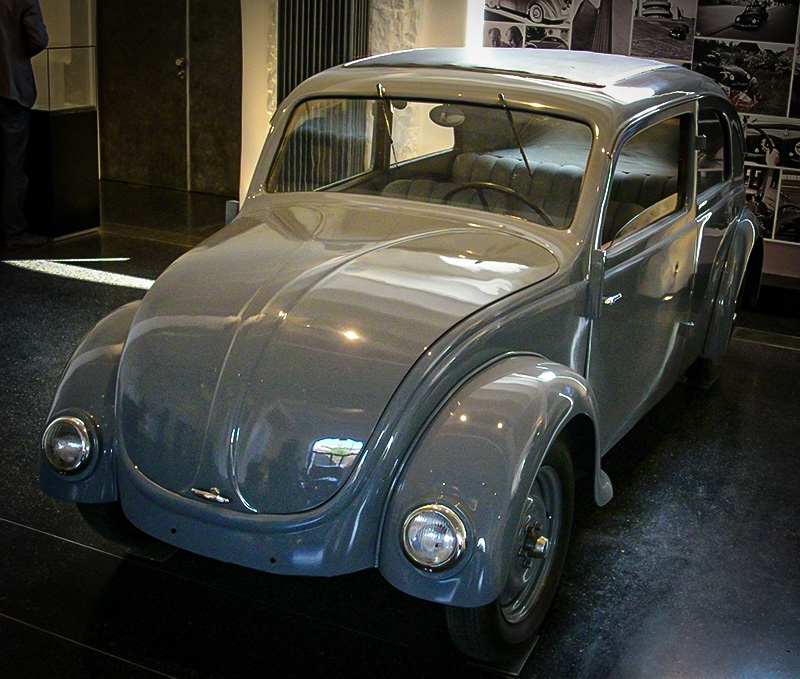
For all his racing success, Ferdinand Porsche’s most influential design may be his simplest. Commissioned by the German government in 1933 (at the same time as the Auto Union racers), the Volkswagen Type 1, later known as the Beetle, was intended to be a Volkswagen, a people’s car.
In contrast to the Silver Arrow, Porsche’s solution was brilliant in its restraint. The rear-engine, air-cooled layout reduced complexity, improved reliability, and allowed for a flat interior floor. Early prototypes used a 985cc flat-four engine, while later pre-war production models produced 25 horsepower from a 1,131cc flat-four. The Type 1’s rounded shape was not a stylistic whim but the result of aerodynamic efficiency and mechanical packaging.
Porsche’s minimalistic design became one of the most recognizable and longest-running automotive forms in history, proving that timeless aesthetics can be attained without ornamentation. The original classic, air-cooled Beetle ceased production in 2003 with a jaw-dropping total of 21.5 million built.
Ferrari 365 GTB/4. Photo: PeterHoch, CC BY-SA 4.0, via Wikimedia Commons.
While Ferdinand Porsche himself did not live to see the full rise of the Porsche brand, his design philosophy directly shaped it. The Porsche Type 64 is the case in point. It is considered the spiritual ancestor of later Porsche sports cars, combining lightweight construction, aerodynamic efficiency, and durability, not to mention the shape that would define both the Porsche 356 and the legendary 911.
Developed from Volkswagen Type 1 components, Porsche sketched out an eye-catching streamlined, aluminum body with a “raindrop” shape. Powered by a 50 horsepower 1.1-liter flat-four, the Type 64 had an estimated top speed of 160 km/h (100 MPH). Three examples were built for a 1939 Berlin-to-Rome race that was cancelled at the start of WWII.
Of the three, one was destroyed during the war, one was captured post-hostilities and taken on a fatal joy ride by GIs, and one survived.
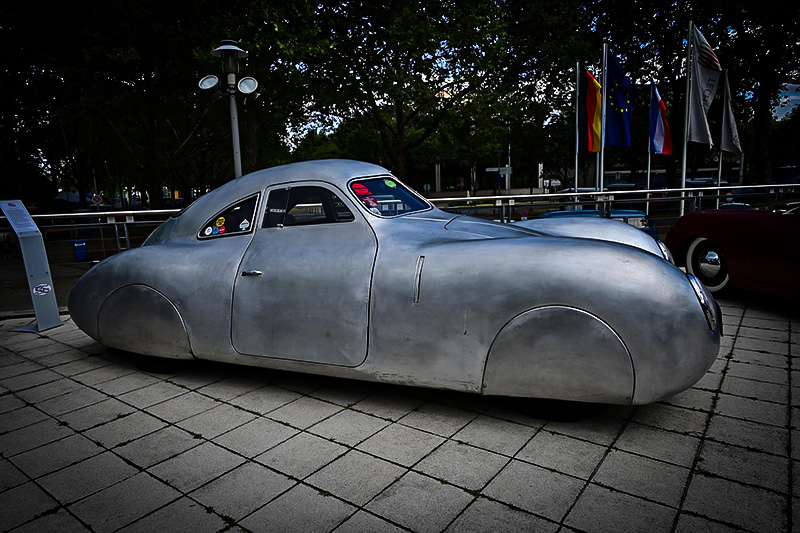
1939 Porsche Type 64. Photo: Hansa1954 via Pixabay.
The survivor made headlines on the auction block during Monterey Car Week in 2019. Some jumbled jargon got in the way when the auctioneer said “fifteen” and “sixteen” million, the bids were misheard, and the scoreboard displayed “fifty” and “sixty” million. True bidding reached $17 million but fell short of the seller’s reserve.
Chris Harris of “Top Gear” had the opportunity to drive that lone survivor, and the video is worth a watch.
While Porsche’s son Ferry completed the 356 after World War II, its engineering DNA had long since been laid out. The 356 has the distinction of being the first production Porsche sports car. It was powered by a 1.1-liter, air-cooled, four-cylinder boxer engine (sourced from Volkswagen) with an output positioned between the Type 1 and Type 64 at 35 horsepower.
The 356 went through four iterations (Pre-A, A, B, and C) with the early Pre-A models identifiable by their two-panel windscreens that were divided by a center bar. The car’s production run spanned from 1948 to 1965 and totaled between 76,000 and 78,000 units.
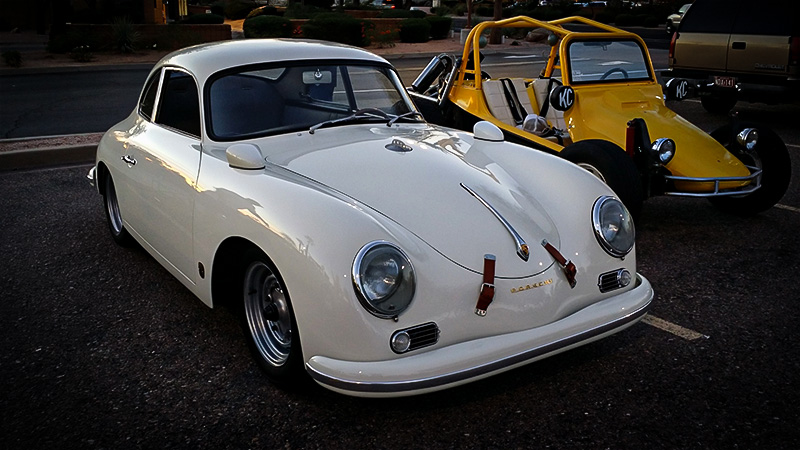
1948 Porsche 356. Photo: “Porsche 356” by Nick Suprik — Public Domain (CC0), via PublicDomainPictures.net.
Ferdinand Porsche died on January 30, 1951, at the age of 75, in Stuttgart, West Germany.
In the years leading up to his death, Porsche’s health had declined significantly. He was arrested by French authorities in 1945 and imprisoned for nearly two years without trial on accusations related to wartime activities. Although he was eventually released, the imprisonment took a serious toll on his physical condition.
Porsche returned to Germany, where Ferry increasingly took over leadership of the company. Ferdinand Porsche lived long enough to see the early success of the Porsche 356, and one wonders if he could have envisioned what his brand would become from such humble beginnings. According to Porsche and industry data, around 70% of all Porsche vehicles ever built are still on the road today. That’s even more impressive when you consider how old the brand actually is.
Like many successful designers, he championed concepts like platform efficiency, drivetrain-led design, aerodynamics, and motorsport-derived engineering, but few have conjured basic automotive shapes that have lasted as long as Ferdinand Porsche.
And it is this enduring influence that solidifies his place as an automotive paragon.
The articles and other content contained on this site may contain links to third party websites. By clicking them, you consent to Dorman’s Website Use Agreement.
A nationwide framework of safety regulations has transformed vehicle design and saved countless lives since its introduction in 1968.
The Japanese Domestic Market performance car you’ve waited 25 years to drive is finally ready for legal export.
Did you know that fuel blends change with the seasons in the United States?
Cars have a backup cooling system—use it when the situation demands!
Tracking Pininfarina’s career from the beginning to 1987.
Tracking Pininfarina’s career from the beginning to 1987.
Participation in this forum is subject to Dorman’s Website Terms & Conditions. Please read our Comment Policy before commenting.