Customers don’t realize it needs attention. Sadly, many mechanics don’t, either.
The Most Neglected Part of the Cooling System
read more



Customers don’t realize it needs attention. Sadly, many mechanics don’t, either.
In 2023, a record number of vehicles were stolen in the United States; 1,020,729 vehicles to be exact. While that number has declined over the past couple of years (850,708 in 2024 and 659,880 in 2025), car thieves haven’t given up. In fact, they’re finding more technologically savvy ways to get access to a car.
Two methods that thieves have been using in at least the past few years are relay attacks (amplifying the signal between the car and the keyless entry remote to gain access to the vehicle) and CAN injection attacks (gaining access to the vehicle by using a CAN-injector disguised as something harmless, like a speaker). If you want a deep technological analysis of how these attacks are carried out, read this Ars Technica article. But the key takeaway is that thieves can carry out these attacks in as little as two minutes.
So, let’s talk about six ways you, as a mechanic or a vehicle owner, can prevent this from happening. Many of these tips were inspired by this page on AAA’s website, “How to protect yourself from keyless car theft,” and ”How to Prevent Keyless Car Theft” on WikiHow, co-authored by a police captain from the Mountain View, California Police Department.
The signal your keyless entry remote sends to your car to open it is a radio frequency (RF) signal. An RF signal is an electromagnetic wave used to transmit information wirelessly across specific frequency ranges. It’s a very common type of signal; in fact, it’s the same type of signal that your garage remote sends to the garage door to open it.
Thieves know they can amplify that signal to gain access to the vehicle. According to the Ars Technica article linked above: “Keyless fobs typically only communicate over distances of a few feet. By placing a simple handheld radio device near the vehicle, thieves amplify the normally faint message that cars send. With enough amplification, the messages reach the nearby home or office where the key fob is located. When the fob responds with the cryptographic message that unlocks and starts the vehicle, the crook’s repeater relays it to the car. With that, the crook drives off.” So, what can you do to prevent this type of relay attack? Block the signal as best you can.
Store your keyless remote in a Faraday cage or pouch, or an RFID-blocking bag when not in use. These are available online and in many stores now. They are even making RFID-blocking purses, messenger bags, and backpacks.
If you’re a shop owner or mechanic, invest in a signal-blocking/Faraday key box to store all of your customers’ keys in. Some automakers (Honda, for example) make keys with the keyless entry remote built into them. To keep your customers’ keys safe, it’s probably best just to store all of them in a signal-blocking box.
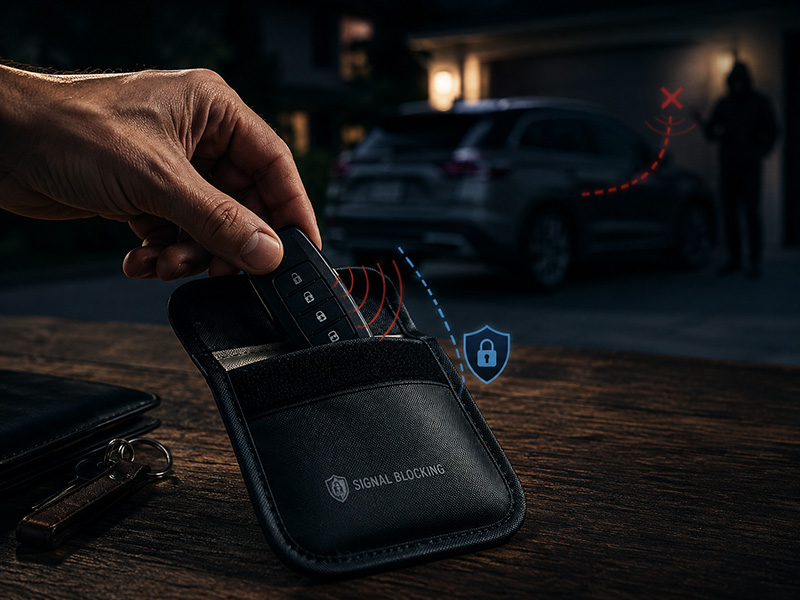
A signal-blocking pouch helps protect your key fob. Photo: AI-generated image created with OpenAI.
As mentioned previously, thieves are using relay attacks to gain access to vehicles through keyless entry remotes from a distance. As such, always keep your keyless entry remotes away from doors or windows in your home or shop. Place any of your keyless entry remotes in a drawer or cabinet away from walls and windows to reduce exposure to relay devices.
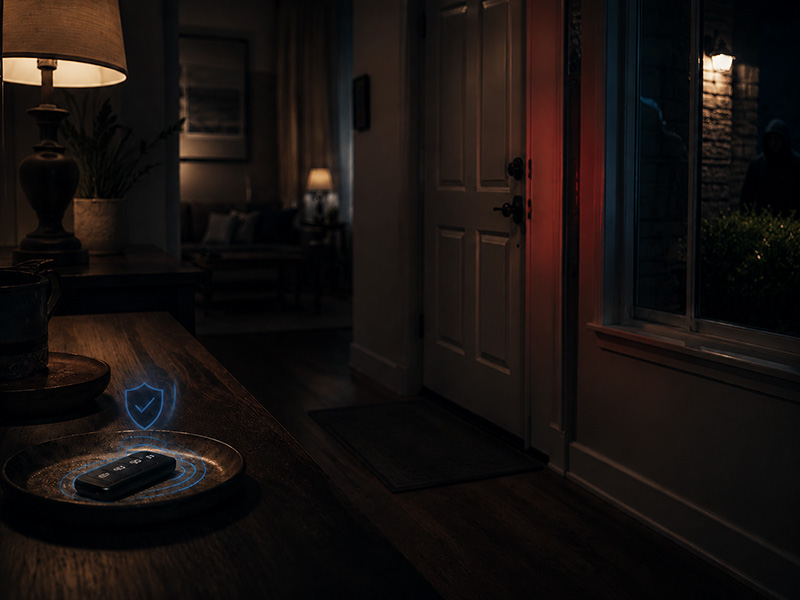
Store key fobs away from doors, windows, and exterior walls. Photo: AI-generated image created with OpenAI.
The rule that your parents (hopefully) instilled in you still applies: always lock your vehicle. Before leaving your car, check that the locking plungers move, listen for the click, and watch for the lock indicator. Of course, you can always give the door handle a pull, too! Be alert for signal jamming, which can make the lock fail mid-operation.
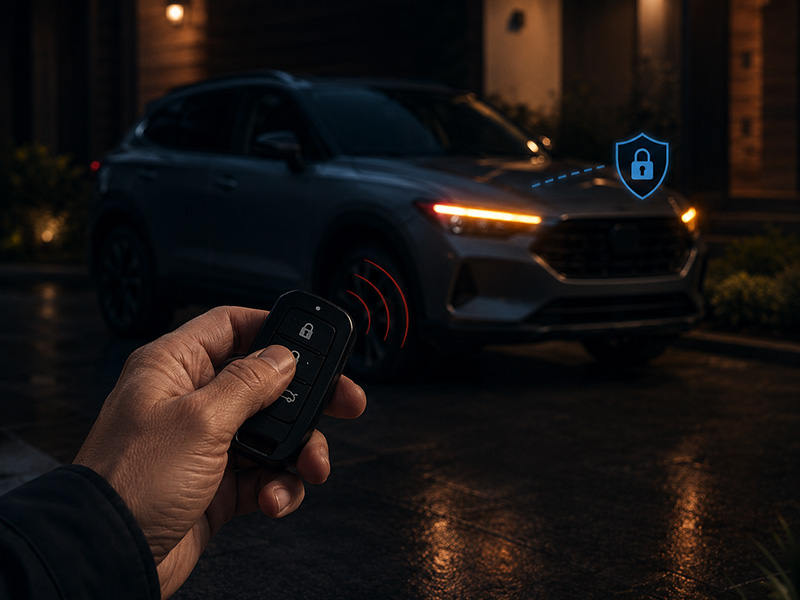
Always double-check that your vehicle is locked. Photo: AI-generated image created with OpenAI.
No RF trickery can defeat a physical club or shift lock. If you’re sufficiently concerned about theft, install steering wheel locks or steering column locks on your vehicle. Around your home or shop, add perimeter fencing and motion lighting to deter theft. And, if you’re a mechanic or you run a shop, be aware of customers who use additional locking devices. Make sure they leave the club/shift lock key with you!
Whenever you’re leaving your home or shop and using your remote to unlock your car, it’s probably a good idea to take a look around for anyone just sitting idly in a nearby vehicle to be aware of potential relay attacks. But particularly in busy or poorly lit areas, thieves may use jammers to block the lock signal. If you suspect jamming, try locking again or using a different remote. Or, if you really want to be safe, ditch the keyless entry remote and just use the good, old-fashioned key for now (if you still have one).
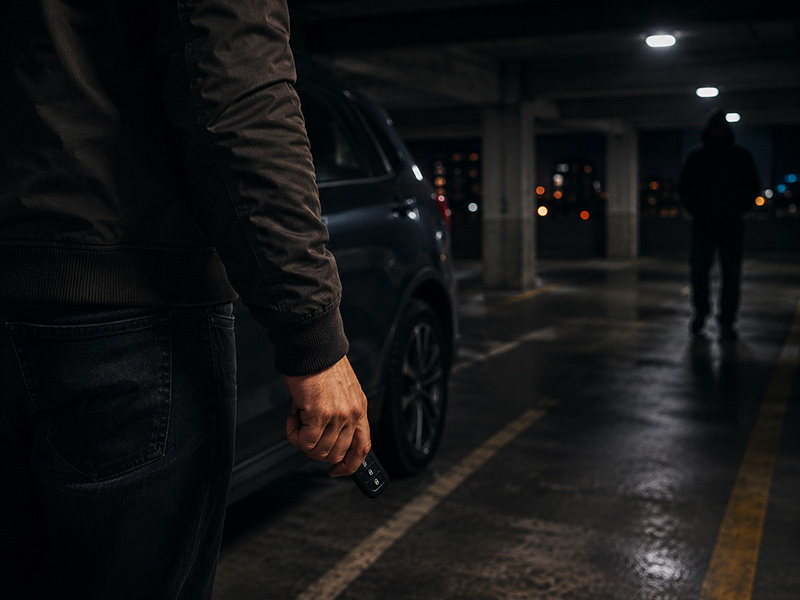
Awareness is key in parking lots and garages. Photo: AI-generated image created with OpenAI.
AI-powered systems can detect suspicious behavior, issue live audio warnings, and alert police in under 90 seconds. While not a standalone fix, they do add a layer of real-time protection.
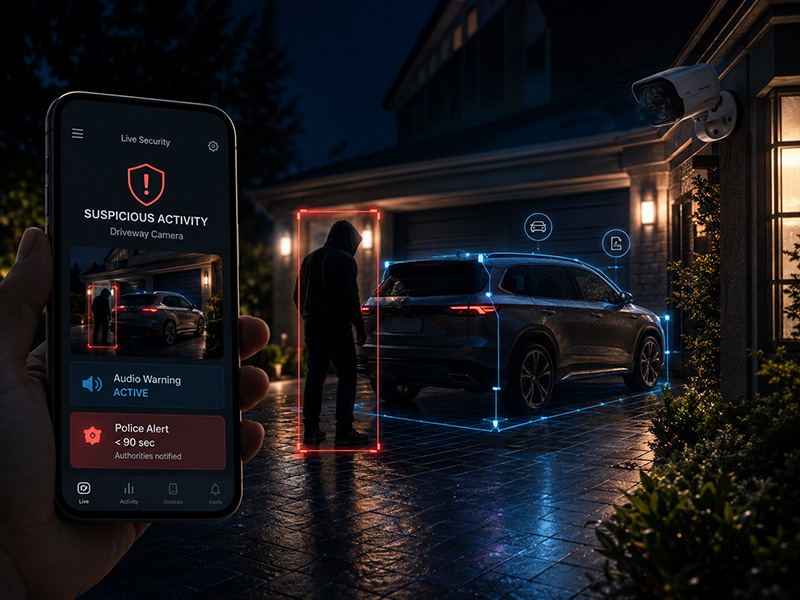
Smart alerts can help detect suspicious activity. Photo: AI-generated image created with OpenAI.
The articles and other content contained on this site may contain links to third party websites. By clicking them, you consent to Dorman’s Website Use Agreement.
If it ain’t broke, don’t try to fix it.
Can a vehicle’s air filtration help keep you safe from wildfire smoke and poor air quality?

The 454 SS combines the time capsule looks of the GM GMT400 platform with an entertaining drive that harkens back to the muscle car heyday.
Spoiler alert: yes!
Pocket check!
Salt isn’t so good, but for many vehicles, a little pepper goes a long way.
Participation in this forum is subject to Dorman’s Website Terms & Conditions. Please read our Comment Policy before commenting.